Yesterday I watched an Instagram creator with more than two million followers, on camera, asking her audience to buy her books and join her paid community. This wasn't a promotion, she was almost begging. In the video she described what had been happening on the last year and in her own words for what her sales had done: zero, down from around a thousand books a day, eighteen months ago.
It was disheartening to watch, genuinely. She sells on Amazon. She built her audience on Instagram and YouTube. Nowhere in any of it, as far as I could see, was an email list of her own. Those thousand-a-day buyers were never her customers because they belonged to the platforms she sold and promoted through, and when something shifted, an algorithm, a policy, a change nobody outside the platform ever gets an explanation for, two million followers didn't stop her sales numbers hitting zero.
That's why the numbers I actually track have nothing to do with likes, views or how many followers an account has and it's also why this whole category is being written from djangify.com's own current position: zero followers, zero traffic, documented as it's built rather than taught from an audience that already existed before the first article went up. I've written more on that starting point in Building Traffic From Zero.
In this post: What Followers and Likes Actually Buy You . The Metrics That Actually Matter . Why Email Is the Metric That Survives a Platform Shift . Setting Up to Actually See This . What to Track Instead of Likes
What Followers and Likes Actually Buy You
A follower count and a stack of likes feel like progress because they're visible, they go up, and checking them gives a small hit of reassurance (and dopamine) that something is working. What they don't buy you is any actual claim on those people because a follower is a follower of the platform first. You get access to them for exactly as long as the platform decides to show them your content, and not one day longer and when the platform decides not to show your content or reduce the amount of access there is nothing you can do.
That's not a criticism of platforms. Instagram, YouTube, Pinterest, Amazon, they are all useful and all worth using and the mistake isn't using them, it's mistaking activity on them for an owned asset, and building a business on that assumption without ever converting the attention into something that's actually yours.
The Metrics That Actually Matter
For anything search-led, what I watch is clicks to the site, how long people actually stay once they arrive, and which content they engage with. For every social account, there's exactly one goal: get people off that account and onto the email list. Eight people joining the list in a day beats twenty likes and eight comments with nobody joining, every single time. I have watched creator after creator tell me that a video with modest views and real signups has done more for their business than one with big views and none. I have also heard stories of creators with millions of followers who are earning next to nothing from their accounts.
None of that means ignore what's happening on the platform entirely. It means checking the number that actually protects the business, not the one that just feels good to watch climb. I am guilty of that myself, when I first opened an Instagram account and found myself climbing quickly I loved it and people still promote these products where they boast about getting 2,000 new followers in 5 days. The truth is if you join in with enough follow4follow accounts it really isn't hard to do but none of those follows are real and other than a follow there is no other engagement. In fact I have seen people complain that many people follow and then unfollow a few days later.
So, I decided not to obsess with views and likes and such but to just focus on my analytics account to see where people are coming from and what they do once they get to my site.
Why Email Is the Metric That Survives a Platform Shift
An email list is the one number in this entire list that isn't rented. Nobody can change an algorithm and quietly reduce how many people see the next email or suspend an account and take the list with it. It sits outside every platform's control, which is exactly why it's the only number worth building a business around long term. When I first started in the world of internet marketing "the money is in the list" was the phrase everyone kept shouting about in their training. I only wished I had paid more attention to that saying while I was busy earning money online by selling my time!
Anyway, going back to the actual lesson from watching that creator ask two million people for money and get nowhere near enough back. It's not that she did anything wrong building an audience on Instagram and YouTube. It's that none of it converted into something she still owned once the platforms stopped cooperating. A thousand sales a day looked like a business. Without a list behind it, it was a thousand transactions a day happening to pass through a business that never actually got built.
Setting Up to Actually See This
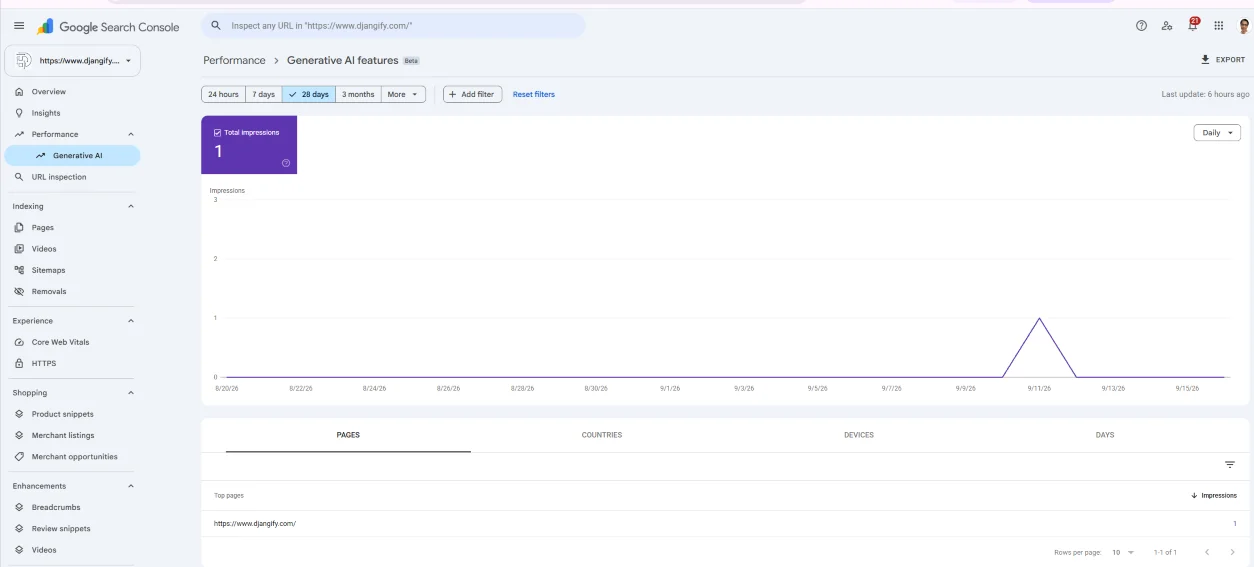
Google Search Console and Analytics both connect directly inside a Djangify shop's Site Settings, and between the two of them they show what's actually working, not what merely looks active. Search Console specifically is worth checking for articles that have been crawled but not indexed. That usually means the piece needs strengthening, not that it's fine and simply waiting its turn.
Your Site Audit is worth checking alongside both. Connect an AI to it and it will tell you plainly what's still holding your shop back from being found, rather than leaving you to guess.
What to Track Instead of Likes
Pick one number that isn't a vanity metric and check it after every piece of content you publish, not the like count, the signup count. Every platform you use should have one clear job: an email opt-in on the way to a purchase, a free hosted tool offered as a lead magnet, a lead capture on a landing page. If a piece of content doesn't have a route from wherever it's posted back to your list, that's the gap to fix before the next piece goes out, not the follower count.