I've stopped asking how to rank on Google. I've started asking a different question: how does an independent business get understood by AI.
In this article:
- The problem with owning your own shop
- What I actually asked AI
- What AI needs to know about a product
- Product Knowledge: teaching Djangify what a product is for
- Product Q&A, and a name behind the work
- A file written for machines: llms.txt
- Djangify checks this for you now
- AI can hand out information. It doesn't have your experience
- The experiment: Self-Talk Effect first, then every Djangify shop
The problem with owning your own shop
Etsy already has people. Someone goes there to buy something, searches, compares, buys. The seller gets access to an ecosystem that already exists.
Build your own shop instead and the journey looks different: customer finds you through Google, AI, social or search, then lands on your website, then your shop, then your product. You own the shop, the customer relationship, the code. You also own the discovery problem Etsy solved for its sellers.
That's the trade every independent business makes when they choose ownership over renting space on someone else's platform. I built Djangify for people making that trade. Lately I've been asking what Djangify can actually do about the discovery half of it.
What I actually asked AI
I put a hard question to it directly: are you stealing my potential customers by giving them generic advice, even though I have lived experience of the topic? If we all go out of business, where do you get your new content from? Will you just make things up?
I think every independent digital business needs to sit with that question, because AI can already answer a lot of what people used to pay for. Ask it for a 90-day plan and it gives you one. Ask for journal prompts and it gives you fifty. Ask how to improve your self-talk and it gives you suggestions. Generic information products are exposed, and pretending otherwise doesn't help anyone.
But there's a difference between AI handing someone information and someone choosing a specific person's framework, workbook or method, built from years of doing the actual thing. AI can explain a technique. It doesn't have the experience that produced it, and it shouldn't pretend to. That distinction is what the rest of this is built around.
What AI needs to know about a product
There are two separate things an AI system can discover about an independent shop.
The first is the product itself. Someone asks "I need a workbook for negative self-talk, what should I look at," and if a shop sells the right thing, the systems answering that question need to understand what the product actually is, not just its name and price.
The second is the business behind the product: who made this, what do they know, who is their work for, what problem do they address. Djangify already had a foundation here through the business's own EEAT and creator information. The gap was that this relationship never touched the product itself, only the site as a whole.
Product Knowledge: teaching Djangify what a product is for
A product page normally says: title, price, digital download. A search engine can work with that. An AI system trying to decide whether to recommend the product needs more: what problem it solves, who it's for, what makes it different from the other ways to solve the same problem.
That's what Djangify's new Product Knowledge fields capture, sitting separately from the sales description you write to persuade someone who's already found you: problem solved, who it's for, what makes it different, and the terms someone would actually search before buying.
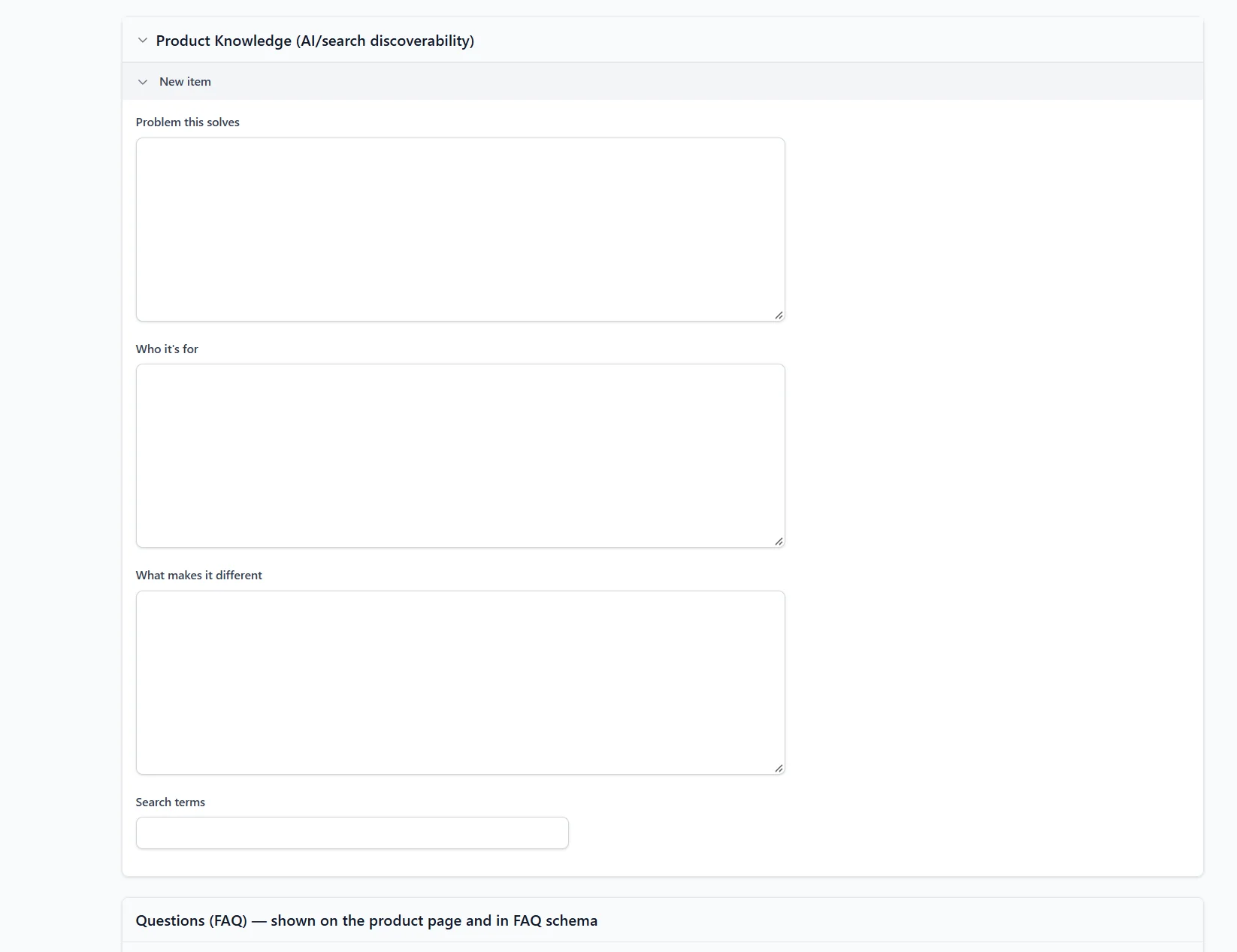
The owner can fill this in by hand, or connect their own AI key (Claude, ChatGPT or Gemini, the same bring-your-own-key setup Djangify already uses elsewhere) and generate a first draft from the product's own title, description and price. Nothing saves automatically. The draft lands for review, the owner edits or rejects it, and only then does it get attached to the product. AI is structuring the expert's knowledge here. It isn't supplying the expertise.
Product Q&A, and a name behind the work
People don't search for a product name. They search for the problem, and increasingly they ask AI directly. So the product page can now carry its own question-and-answer pairs, generated the same reviewed way as Product Knowledge, showing up both on the page itself and as FAQ schema for anything reading the page's structured data.
That second part matters more than it sounds. Google's own guidance treats structured data that doesn't match what's actually visible on the page as a red flag, so the schema and the visible questions have to say the same thing. Djangify writes both from the same source, every time, so they can't drift apart.
The other piece is smaller but does real work: every product page now credits its creator directly in its structured data, name and a short credentials line, connected to a Person object the same way this is already done for blog posts. It's deliberately light. Nobody needs a full biography under every product. What it needs is the relationship stated plainly: this person made this thing. A shopping agent that fetches a single product URL in isolation, which is a genuinely common way these systems work, now has that relationship on the page it's actually reading, instead of only on a homepage it may never visit.
A file written for machines: llms.txt
Everything above lives inside a normal web page, wrapped in HTML for a browser to render and a search engine to crawl. llms.txt is different. It's a plain text file, in Markdown, written specifically for AI systems to read directly rather than parse out of a page.
Every Djangify shop now generates one automatically, at yourdomain.com/llms.txt: the business, its Pain/Person/Promise positioning, every live product with its Product Knowledge summary and price, the shop's pages, and its blog. No setup, no separate content to write. It updates itself as the catalogue changes. robots.txt already told AI crawlers which parts of a site they're allowed to read; llms.txt tells them what the site actually is, without making them guess from the HTML.
Djangify checks this for you now
Djangify's Site Audit, the same dashboard that already flags a missing meta description or an uncategorised product, now has an AI Discoverability section. It looks at every published product and flags the ones with no Product Knowledge and no Q&A yet, with a direct link to fix each one.
The point isn't to guilt anyone into filling in fields. It's that "make your shop AI-readable" is a vague instruction nobody can act on, and "these three products are missing this specific thing, click here" is one they can.
AI can hand out information. It doesn't have your experience
This is why I don't want Djangify shops selling plain information. A method, a framework, exercises, a particular way of working through a problem, a body of work built by an identifiable person: AI can explain those things once they exist. It can't produce them, and a product built from one holds up in a way a generic PDF of tips doesn't.
I want someone who lands on a Djangify shop, however they got there, whether that's Google, ChatGPT, YouTube, Pinterest or a friend's recommendation, to find a real person, a specific problem being addressed, and a product distinctive enough that no other business could have made it. Then a way to buy it directly from the person who made it, with nobody's cut taken out along the way.
The experiment: Self-Talk Effect first, then every Djangify shop
I'm testing this on The Self-Talk Effect first, because it's a real business, not a hypothetical one. I'll fill in Product Knowledge and Q&A properly on its products, then ask AI systems the actual questions a buyer would ask: not "can you find my website" but "I keep being hard on myself, what can I do about negative self-talk" or "is there a workbook for changing how I talk to myself, not just an article." Then I'll check what comes back. Does the product show up? Does it understand what the product is for? Does it know who made it?
Once I know what actually moves the needle, the question becomes what Djangify should do automatically for every shop running on it, not just the one I'm testing on.
That part isn't hypothetical either: I already have a shop that's been sitting untouched on Djangify for a while, that has every feature in this article live on it, the same week I built them, without its owner doing anything. That's the actual point. Not a hundred identical Djangify sites saying the same thing, but a hundred different experts, with a hundred different products, each one better understood by the machines increasingly standing between people and the things they're looking for online.