Last week I updated the Djangify eCommerce builder by connecting Claude directly to it over the Claude MCP (Model Context Protocol) and adding an AI Assistant to the site that performs things like site audit. A major update that will save me hours of admin time and I nearly forgot to mention it.
The Djangify AI Assistant
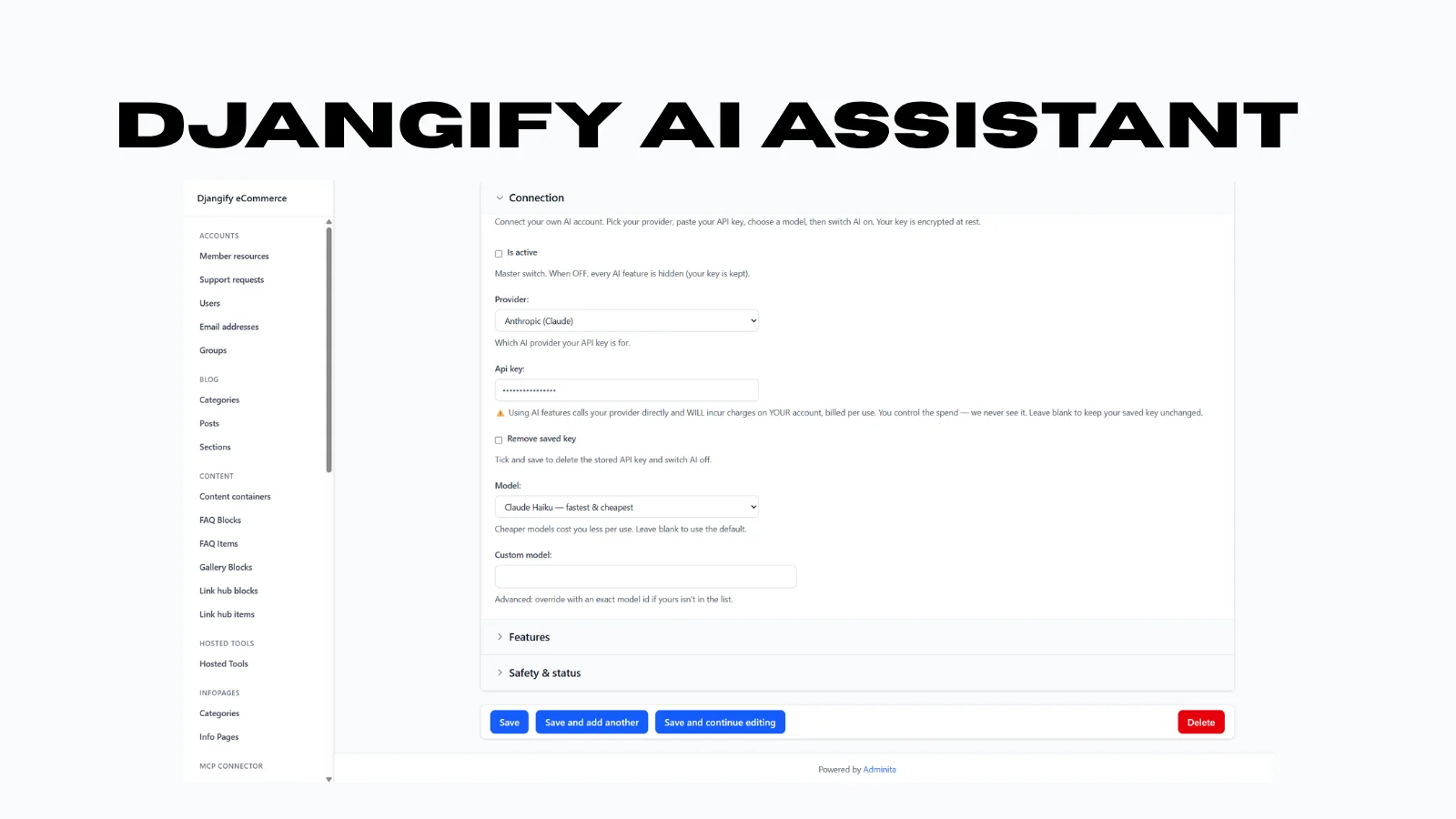
There's now a built-in AI assistant in the Djangify admin that you can just ask questions. This is not a generic chatbot bolted on the side. It actually works from your site's own content. Your products, posts, pages, and settings. Ask it something about growing your site and it's answering from what's actually sitting in your database, so it uses your own information, it's not a guess about ecommerce in general.
To use it you simply connect your own AI key. You can use Claude, ChatGPT or Gemini and alongside the assistant chat you get a product-description writer, a blog writer, and an FAQ generator, all working from the same real content. Nothing auto-publishes. Everything lands as a draft for you to approve, same as it should be because it is really important that you read and edit anything AI gives you.
The Site Audit
Sitting next to the assistant is a proper Site Audit. It is rule-based so no AI call is needed, which means it costs nothing to run and it's instant. What does rule-based mean? Usually an AI-powered audit would call out to Claude, ChatGPT, or whichever model, and each of those calls costs money and eats into whatever usage cap you've got. A rule-based check doesn't touch an AI API at all, so you can run it as often as you like at no cost.
The audit scores your site across four sections - Shop, Content & Pages, Blog, and SEO & Trust - and gives you a prioritised list of what to fix in each one, with a severity rating and a direct link to the thing that needs attention. It's the same audit I use myself to see where a site (including this one) is actually falling short, rather than guessing.
Connecting Claude directly, over MCP
This is the one I actually want to tell you a story about, because it's the update that changed how I work, not just what the site can do.
Djangify now exposes an MCP connection, which means I can open Claude wherever I already am and ask it to do things on the site directly. No more copy-pasting between tabs, or logging into the admin to do it myself.
Here's an actual example: I asked Claude to go through what we'd shipped for the month of July (2026) - things like the free checkout work, topic cluster pages and shop setup wizard and write it up.
It went and looked at what had actually changed, pulled the real detail out of it, and wrote three separate posts, each one landing in my blog as a draft, not published. I didn't touch the admin once. I just asked, in a normal conversation, and came back to three drafts sitting there waiting for me to read through and reshape into my own voice - which I ALWAYS do, because it's my name on this blog and I want it to sound like me. It's getting better at getting close to my voice on the first pass the more we've worked together, but I still go through and edit every one before it goes live.
That's the actual point of this update. Not "AI can write your blog for you" but that the repetitive, unglamorous parts of running an eCommerce site (writing up what shipped, checking what needs fixing on the site, drafting product copy) can now happen while I'm just talking to Claude, and the parts that need my judgment - the final edit, brand voice, and most importantly the decision to hit publish, they all stay exactly where they should: with me.
What this saves you
If you're running a Djangify site solo (and most people doing this are) the time sink was never the big decisions. It was the constant small stuff: writing a description for every product, drafting the next blog post, remembering to check whether your SEO fields are filled in. The assistant, the audit, and the MCP connection are aimed squarely at that pile, so more of your time goes toward the product and the customers, not the admin.
Two ways to run Djangify
If you're reading this and don't have a Djangify eCommerce builder yet, there are two paths in:
Managed Hosting. Pick a subdomain, complete checkout, your site is live in minutes. I handle the servers, backups, security updates and SSL. You handle the products and the selling. Limited to 20 spots at this price.
Self-Hosted. The complete platform as source code, installed on your own server. You own the code, the data and the Stripe account outright with no monthly fee, no platform commission, ever. Built for anyone comfortable on a server, or willing to lean on Claude or ChatGPT with the included setup guide.
Same platform, same zero platform fees on sales either way and just a different amount of infrastructure you want to own yourself.