I have decided that it's time to stop adding features to Djangify, although I said that in July and August! Between 1 September and 20 October 2026 I made 115 changes to it, and the last one went in this week. This post is the record of what is in the finished version, and my reasons for calling it finished.
In this post: Why I built it . What went in . Why I am stopping here . What I do next . A check for your own setup
Why I built it
The truth is I wanted a way to sell digital products without having to pay a huge monthly fee and be at constant threat of things changing at a whim and being shut down overnight - I saw that happen to a few people. Plus, I trained as a software developer and wanted something to build. Around the same time I was asked to build an ecommerce/classroom site and after building that I thought why not build one for myself.
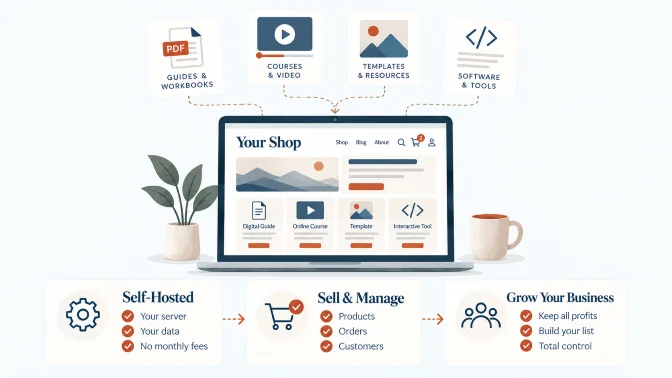
Djangify is an ecommerce builder for digital products. I built it around three promises: your data is yours, there are no marketplace fees, and nobody can shut your site down overnight.
What went in
The more I used it the more I wanted to add. Everytime I thought I was done there was something else and with the help of a few beta testers who also provided ideas it has grown a lot since my first completion date in January 2026. Here is the list, grouped by what each change does for a site owner instead of by date.
Selling
- Guest checkout. A buyer can pay without making an account first. The account is created after the purchase, first name is required, last name is not asked for, and the first-password page is worded for someone who has never logged in before. The details are in Guest Checkout and the First Password Email.
- Abandoned cart reminder emails (19 October). They are off by default on a new site, and off means off. See Cart Reminder Emails for Abandoned Carts.
- Order emails and an order timeline. The owner gets an email summary of orders, and each order shows a timeline of what happened to it. See Order Emails, Order Timeline and Refunds.
- One-time offers and order bumps. One-time offers can be set up after registration. Order bumps are checked at checkout. On Managed Hosting, one-time offers are part of the Full plan only.
- Waitlists. A product marked Coming Soon can send people to a waitlist page, and the waitlist link shows on the product cards.
- Questionnaires and Forms. This was the final addition I made. The ability to include a questionnaire and gather results or a form that people can fill in. As I offer custom services as a developer the form was really something I wanted for me.
Building the email list
The sign-up form is now built in: first name, email address and a privacy checkbox. It sits directly on the hero banner and on the newsletter block, in the shade you picked for the banner. The same form is on blog posts, link hub pages, free tools and topic cluster pages, so one setting controls where every sign-up goes.
Each person confirms by email before they join the list (double opt-in). MailerLite tags become groups. On 20 October the questionnaire block became a generic form builder. The full guide is Built-In Sign-Up Forms and Waitlist.
One fix I want to mention: saving an email provider key without the site's encryption key used to store nothing and say nothing. You had no idea it wasn't working and it just never collected email address. It now shows an error so you know both are needed.
Being found, by search and by AI
- Product Knowledge and Q&A on each product page, which feed the structured data search engines read.
- llms.txt, a plain-text summary of the site written for AI systems such as ChatGPT, Claude and Perplexity. I wrote about it in How to Make Your Digital Site Understandable to AI (Not Just Google).
- An AI Discoverability section in the site audit, so the site tells you what is missing.
- A creator credit on product pages and in the product data, so a reader and a search engine can see who made the thing.
- Cleaner structured data (5 and 6 October). I removed a search action that did not exist and a product creator field that was invalid, took out a return policy that was hardcoded to the UK, and added business country and refund policy fields to site settings.
- Alt text fields on image blocks, and slugs up to 200 characters on pages, products and info pages.
How it looks and what goes on a page
- A Manuscript theme with a text-first blog and a plain, editorial product layout, set in Courier Prime.
- The site background setting now drives the navbar, headers and list areas in every theme, and there is a sitewide font picker.
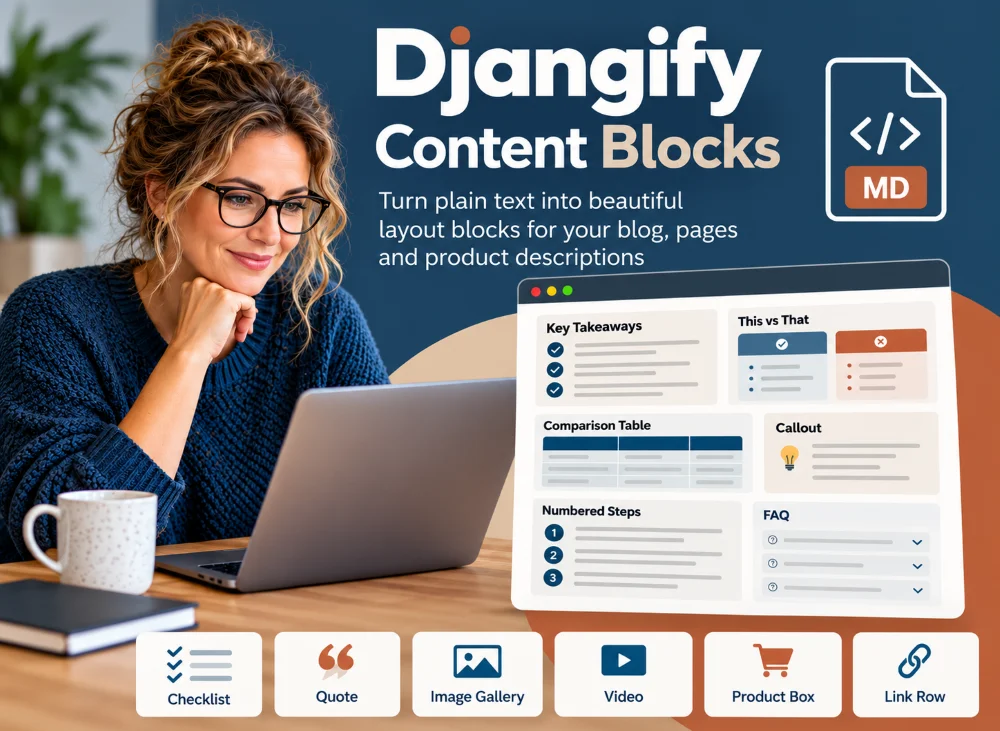
- Content blocks. A free set of ready-made boxes for articles, a Copy button, and a premium set of interactive blocks. The Switch block shows its tabs as a dropdown on phones, and a Countdown block went in on 19 October. See Understanding Content Blocks.
- Three-column sections, and a Two Column Text block with a button for each column.
Tools, the app and help for the owner
- The free hosted tools limit went from 7 to 12, and the tools have share buttons and a visual editor that lets you add more text. I included this because many of the tools were not being indexed by the search engines. Now, I am hoping with some text on the page that might change but it's hard to know exactly what Google is seeing when you add a html file so this is still under review.
- An install banner and manifest so a site can be added to a phone's home screen, with your own wording on the banner. See What is a Progressive Web App on Djangify.
- The Owners Help section is rebuilt as two parts: For You, and For Your AI. Under the AI section are all the files you can download and hand over to your AI so it can help you set up your site.
- Claude can edit pages, products and posts through 8 generic content tools. They replaced about 46 separate ones on 26 September.
- Managed Hosting has Lite and Full plans, with a setup checklist. I decided to allow 14 days free access to both plans. The Lite plan excludes things like the blog and AI but includes enough if someone wanted to sell hosted interactive micro-apps on their site.
The parts nobody sees
- The admin editor was deleting script and style code when you saved. It no longer does (6 October).
- Error logs were being wiped on every deploy because two folder settings did not match. Fixed on 18 September.
- The full-site backup is better, and it leaves out sensitive information.
Why I am stopping here
When I wrote down what I need, the list was short. I need a site where I can sell digital products. I need somewhere to share what I know. I need a way to build my email list by sharing stories and parts of my expertise, and a way to build a relationship with the people who follow me on social media and the people on my list. Plus, I need an income that comes out of that.
I believe Djangify does every one of those jobs now. It's not as if I sit there with a huge list of things I want that I tick off because I am not that organised. No, I use Djangify, something is missing for me and I go ask Claude Code to build it. That's as strategic as I get really. So, I can't say the word NEVER when it comes to building Djangify but for right now I will say... enough... enough now!
I use Djangify on my own sites, so I will keep finding small things and I will fix them as I find them. I will also keep watching for the latest methods in running an independent ecommerce site successfully, and anything that earns its place goes in. From here, the work is publishing.
What I do next
I write and share stories and parts of what I know on my sites, and the people who follow me on social media get a clear reason to join my email list. It is mainly about promoting the sites I have right now, including Djangify. Although, it is mainly a tool for me I am still more than happy if anyone wants to become an owner and join me.
Right now, I judge a day by sign-ups. Eight sign-ups in a day beat twenty likes and eight comments with nobody joining the list. I wrote more about that in Why I Don't Care About Likes (And What I Track Instead).
I have watched an Instagram creator with more than 2 million followers and no email list see her Amazon book sales go from about 1,000 a day eighteen months ago to zero recently. All her eggs were on platforms she did not own. That is the reason the email list sits in the middle of the plan, and the reason the sites are mine.
If you want to follow along while I put this to work, the sign-up form below takes a first name and an email address, and you confirm by email.