Six weeks ago I posted a full tour of everything in Djangify's admin sidebar, six months of work in one place. This isn't that. This is the shorter list: everything I've added since that post went up, so nothing gets lost between the big roundups.
In this update:
- Guest checkout, no account required upfront
- Cart reminder emails for abandoned carts
- A new theme, and a font picker that finally behaves
- A Progressive Web App that installs like a real app
- Teaching AI what you actually sell
- More of the admin, handed to Claude
- The smaller things that add up
- Cleaning up the language
- What's next
Guest checkout, no account required upfront
The old flow asked for an account before anyone could pay. That's one more decision between someone wanting a thing and actually buying it, and every extra decision is a chance to lose them. Checkout now accepts a guest: an email address and a first name, nothing else. Pay, and an account gets created automatically afterwards, so they can still log back in later to redownload their file or check an order. The account exists for their benefit, it just isn't a toll booth on the way to paying you.
Cart reminder emails for abandoned carts
A shopper who leaves items in their cart without paying now gets one reminder email. It works for customers who are logged in, and for guests as soon as they have typed their email address at checkout. A few hours later, the email lists what they left behind and gives them a button that puts the cart back.
You choose how long it waits in Shop Settings. Paying cancels the reminder, and every email has a link to stop cart reminders for good. The full details are in Cart Reminder Emails for Abandoned Carts.
A new theme, and a font picker that finally behaves
Manuscript is the fifth theme in the box: text-first, no images required anywhere, set in Courier Prime, with an Editorial-style site underneath it. It's built for people whose product is the writing, not a photoshoot of the writing.
Alongside it, the products page on Spotlight got a visual pass, and the product page itself is now unified across every theme, so switching themes doesn't leave one page looking like it belongs to a different site. The sitewide font picker had a bug where a chosen font wouldn't consistently apply everywhere it should, that's fixed now too.
A Progressive Web App that installs like a real app
Djangify sites have been installable for a while, the icons were already there. What was missing was the polish that makes an install actually feel like an app instead of a bookmark with extra steps. There's now an install banner with its own per-site custom text, so you control what it says instead of a generic prompt. The manifest picked up the fields PWABuilder recommends and proper Android asset links, which matters if anyone ever wants to package a site for the Play Store rather than relying on a browser install alone.
Teaching AI what you actually sell
This one got its own full post, so I won't repeat it here: How to Make Your Digital Site Understandable to AI (Not Just Google). Short version: every product can now carry Product Knowledge (the problem it solves, who it's for, what makes it different) and its own buyer Q&A, separate from your sales copy. It feeds the product's schema markup, shows as visible FAQ on the page, and gets pulled into a new llms.txt file every Djangify site now generates automatically. Site Audit has a new AI Discoverability section that flags any published product still missing this. Every product page also now credits its creator directly in its structured data, name and a short credentials line, the same relationship the site's EEAT settings already established for the business as a whole.
More of the admin, handed to Claude
The MCP connector keeps growing. Claude can now create, update and delete Info Pages directly (your docs and policy pages), and set a product's Product Knowledge and Q&A with set_product_knowledge and set_product_questions, the same fields described above. As of today, Claude can also read and configure the One-Time Offer, the post-registration tripwire, with get_one_time_offer and update_one_time_offer: which product, any bundled extras, a special price, the headline and button copy, an optional countdown. That one existed in the app since the last update but hadn't been wired into the connector yet, so this closes a gap rather than adding something new to the site itself.
The smaller things that add up
A run of changes too small for their own headline, but they're the kind of thing that makes a site feel more finished:
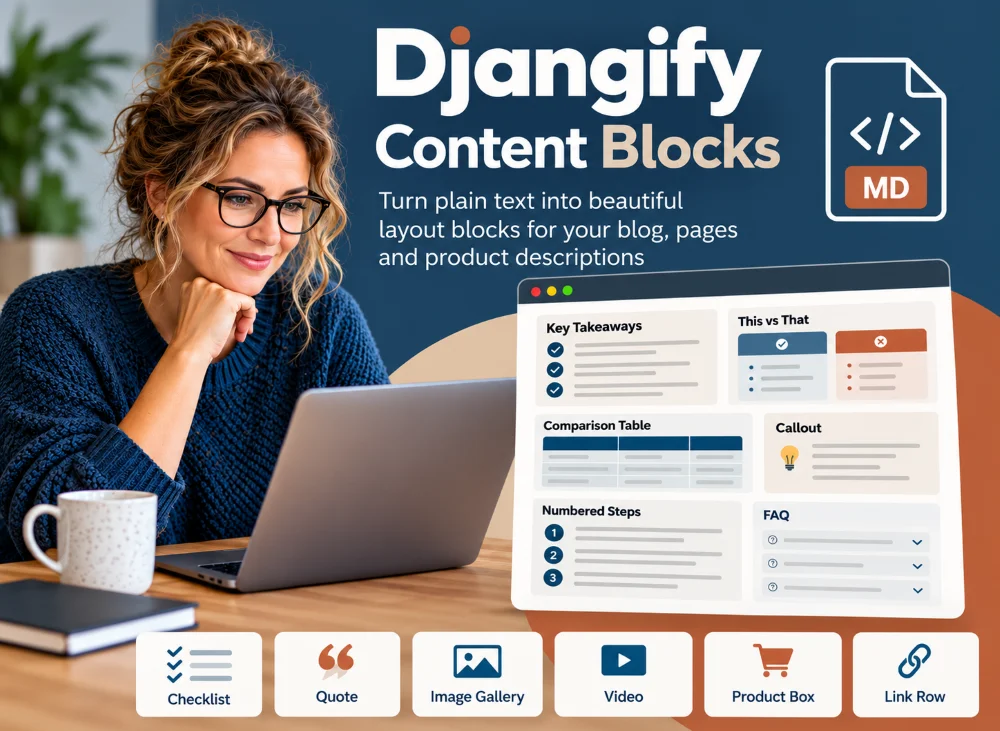
You can now drop a newsletter signup straight into a Hero block, so the very top of a page can carry an opt-in without a separate section. The content blocks that briefly went missing from the site app are back. Hosted Tools descriptions get a proper WYSIWYG editor instead of a plain text box. Owners can opt into a daily order-summary email, one message at the end of the day listing what sold, nothing if nothing did. Reviews got a flag option (with matching privacy-policy wording) plus a general UX and admin cleanup, including editing FAQ content directly from the reviews admin. The Video Hub picked up support for a video's shorts URL alongside the main one. Site Settings has a place to claim a Pinterest ID now. And checkout and login both got a show/hide toggle on password fields, a small thing that stops more people than you'd expect from mistyping a password twice.
Cleaning up the language
I also changed how I describe Djangify. It is an ecommerce builder for digital products, built for my own digital businesses and shared with others, and the wording on djangify.com now says that. The words "shop" and "store" have been replaced with "site" and "products", and the main menu label now reads Products. The aim is simple: your data is yours, there are no marketplace fees, and nobody can shut you down overnight. Shop Setup also gained a field for your Three Ps positioning (pain, person, promise), the same framework I use to plan Djangify's own content, so it's captured once and available to anything that reads your setup, Claude included.
What's next
The next stretch is rolling the AI-discoverability work out properly: filling in Product Knowledge and Q&A across real sites, starting with The Self-Talk Effect, and watching whether it actually changes what AI systems recommend when someone asks a buying question. More on that once there's something worth reporting.