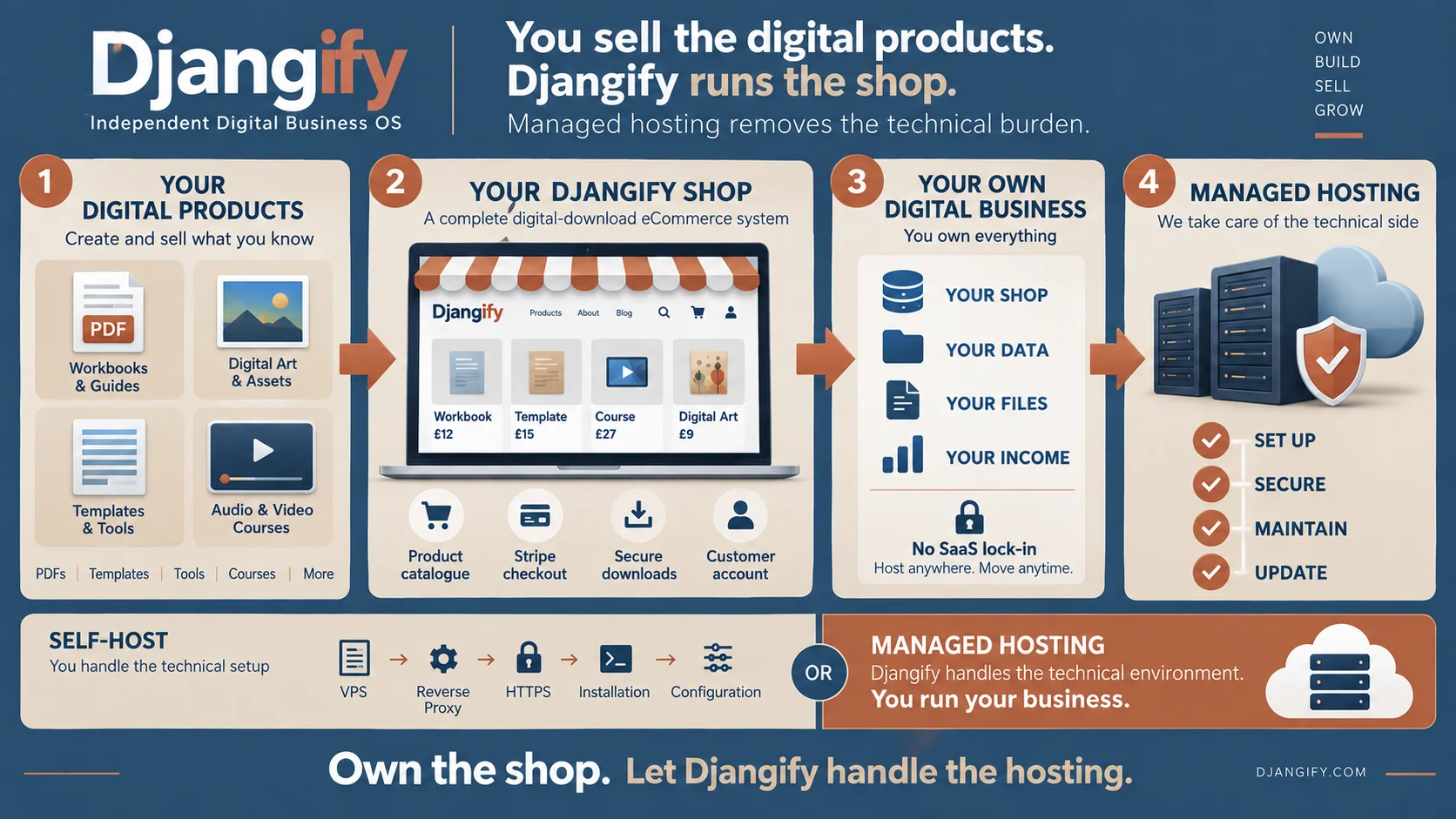
I built the Djangify eCommerce Builder for myself and I run my own business on both versions. This shop is managed hosting and I also have self-hosted versions. This page will help you decide which one suits you and your business based on whether you want someone to run the servers or whether you want to hold every aspect of the site yourself. There's no wrong answer and its easy to switch from managed to self-hosted, so my aim here is to guide you through exactly what each version gives you, what it doesn't and which one fits how you actually want to work.
Djangify Managed Hosting Vs Self Hosting: A Full Guide
If you are weighting up managed hosting against self-hosting, read through this page to help you. This is a straight comparison of what you get, what you give up and what you're actually responsible for with each. I run my business on both, so this comes from using them, not just building them.
What Is Self-Hosting?
Self-hosting means the Djangify eCommerce Builder runs on your own hosting server like a VPS you rent from any hosting provider instead of mine. You buy the software once, install it, and it's yours to run for as long as you want, with no monthly fee to me.
You get the full source code, MIT licensed, so you can customise anything by handing it to a developer if you want work done that's beyond you.
Everything including your database, customer data, products, and backups lives on infrastructure you control.
Self-Hosted - A Quick Start Guide (START HERE)
The starting point for the self-hosted journey — links to every phase of setup, from pre-installation through deployment, in the order you'll actually go through them.
Self-Hosted Pre-Installation Guide (Phase 1)
What your server actually needs before you install: minimum specs, Ubuntu, Docker and Docker Compose versions, a registered domain, and a Stripe account. Useful for checking whether you already have what self-hosting requires.
Self-Hosted Maintenance Essentials Guide
The ongoing work self-hosting doesn't advertise upfront — backups, applying updates, monitoring uptime and disk space, and routine weekly/monthly/quarterly checks to keep a store secure and recoverable.
Self-Hosted Troubleshooting Guide
Common issues you may hit running your own server — Docker, Stripe webhooks, SSL, email delivery — and exactly what self-hosted support does and doesn't cover.
The Encryption Key: Why It's Critical and How to Avoid Losing It
The single easiest thing to get wrong when self-hosting — your Stripe, SMTP and marketing credentials are encrypted with a key you generate yourself, and losing it silently breaks those integrations. Managed hosting customers never have to think about this.
Backups and Downloads: Using the Admin Backup Centre
Both hosting types include a one-click CSV export and full-site backup zip in the admin. On self-hosted it's a convenience, not a replacement for the scheduled server-side backup routine you're responsible for setting up yourself; on managed hosting, scheduled backups are already handled for you.
The MCP Connector and AI Assistant: Choosing What You Use
How to manage your shop from Claude directly, using your own AI provider key. On managed hosting it's a one-click connection from the admin; on self-hosted it's a small sidecar service and two extra reverse-proxy routes you set up yourself.
Self-Hosted: Built-In Testing Commands
Built-in management commands for checking your Stripe and email configuration, your migrations, and running the full test suite — the kind of verification that's on you to run yourself when self-hosting.
Featured Articles
Hosting And Ownership Explained
This article goes into more detail about the type of hosting you need and what it means to own the Djangify software.
Choosing Between Self-Hosted And MarketPlace
What is the difference between selling your products on a marketplace or owning self-hosted software?
What's Included In The Self-Hosted Version
This blog post explains what's available when you buy the self-hosted Djangify version.
From the Shop
Own the whole thing. One payment. No platform fees. Ever.
The complete Djangify eCommerce builder as source code you install on your own server. You own the code, the data and the Stripe account. No marketplace rules, no monthly lock-in, no company that can change the terms on you. Pay once, run it forever. Pay one-time for one license and get the complete source code · Lifetime access to your version · You only ever pay Stripe's standard fees

FAQ
Can I Use AI To Help Me Set Up Self-Hosted?
Yes. I encourage it. There are a number of files in a documentation folder that you can upload to the AI of your choice. It will give it everything it needs to know to help you set the site up and fix any issues if you hit them.
Is This Suitable For A Non-Tech Person
If you are paying a developer to set it up for you then yes. If you are AI savvy and you are willing to get AI to help you while you follow the steps it gives you then yes. If you are neither then no. Managed hosting is a much better option for you.
Do You Offer Support?
Direct support with Djangify yes. Support if you are struggling with your hosting. No. You have full documentation for AI and there is no issue AI can't solve because this is a simple process, I have set it up many times myself. This is why I recommend this to people who are tech-savvy.
People who read this page are also interested in
Sell Digital Products
The economics: what marketplace fees actually cost, and what owning your shop changes.
Lead Generation Studio
The software used with AI to build a 90-day traffic plan for your shop.
How the Djangify eCommerce Builder Works
Every feature, architecture decision and update behind the software both hosting options run on.